

By
Ustaz Dr Muhammad Haniff Hassan
Fellow, S. Rajaratnam School of International Studies, Nanyang Technological University Singapore
Introduction
The Qur'anic portrayal of Paradise often draws on imagery that matches human sensory experience, using familiar terms to point to realities that go beyond worldly understanding. One example appears in Qur'an 76:5, "Indeed, the righteous will drink from a cup [of wine] whose mixture is of Kafur."
The term Kafur has long attracted exegetical interest because of its semantic ambiguity. Classical and modern scholars of tafsir have generally treated it descriptively, linking it to coolness, fragrance, and purity rather than to a specific earthly substance. In this dominant reading, Kafur is either a metaphor for a heavenly drink or the name of a spring in Paradise whose properties resemble a known aromatic substance.
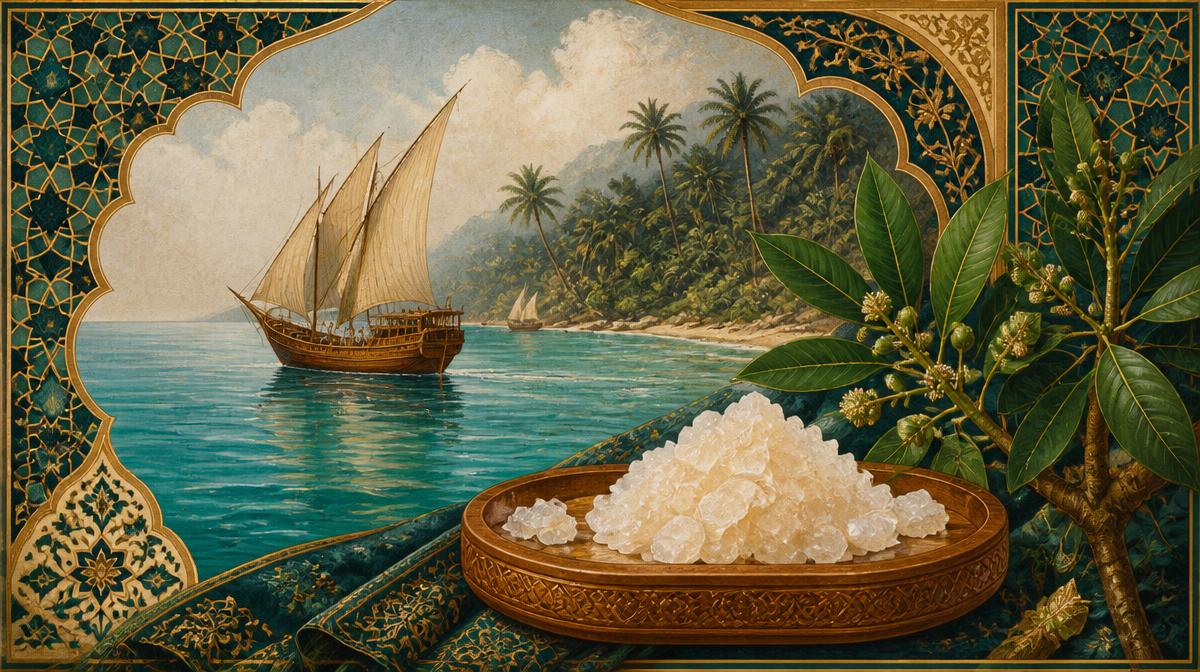
The Southeast Asian scholar Pak Hamka (1908-1981), in his Tafsir al-Azhar, offers a different reading. He identifies Kafur with camphor, a fragrant crystalline substance derived from trees, and connects it to Barus, a historical port city in Sumatra known for high-quality camphor, commonly called kapur barus. Hamka proposes that the term entered Arabic through early trade between Arab merchants and the Malay-Indonesian archipelago, so the Qur'an preserves a lexical trace of pre-Islamic commercial networks.
This article examines Hamka's interpretation against classical tafsir literature, hadith sources, scientific knowledge on camphor, linguistic studies on etymology, and historical records of trade between Southeast Asia and the Middle East.
Pak Hamka's interpretation of Kafur

In Tafsir al-Azhar, Hamka defines Kafur as camphor: a white, fragrant substance extracted from trees that grow in the forests of Sumatra. He highlights Barus as a centre for high-quality camphor, known regionally as kapur barus. He also references classical Malay literary tradition, especially the poetry of Hamzah Fansuri, where camphor carries symbolic meaning. Camphor therefore held both material and cultural significance in the Malay world.2
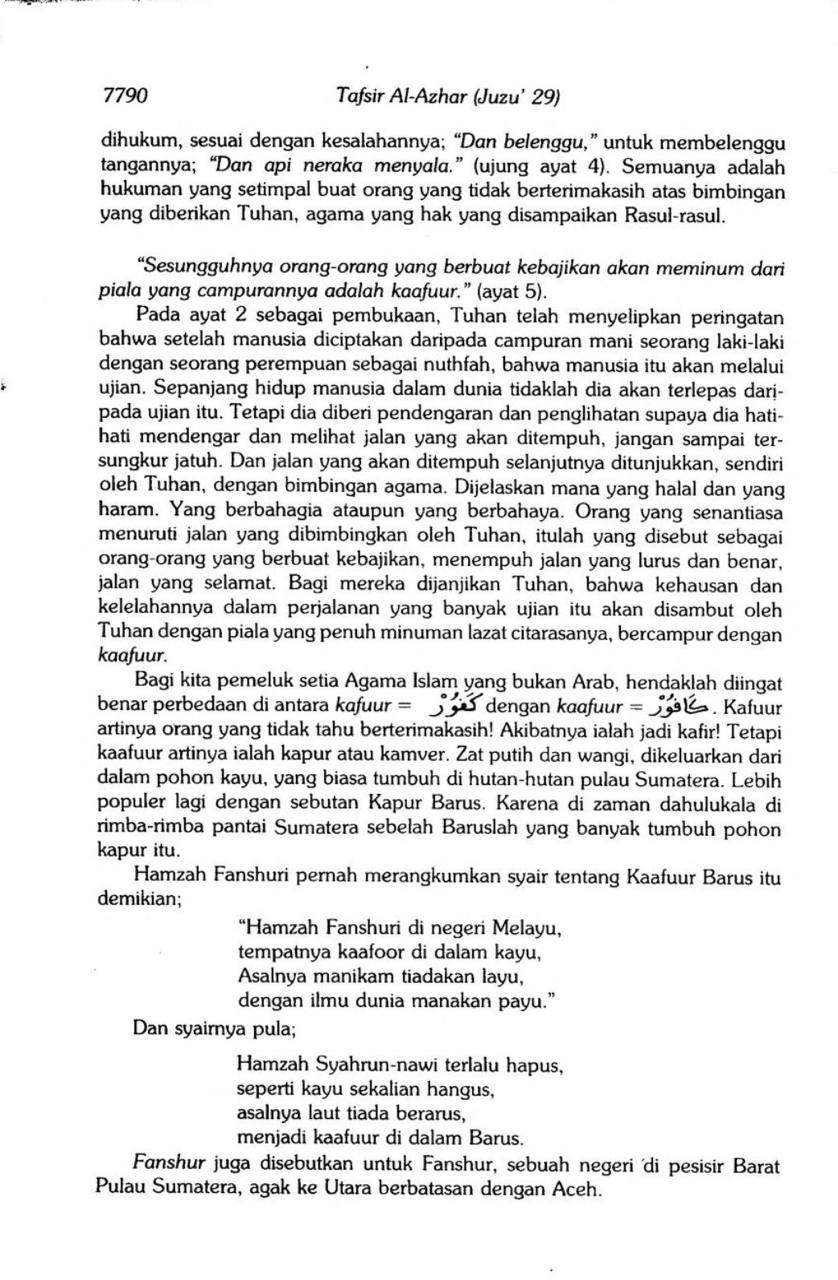
Central to his thesis is the claim that Arab traders engaged in maritime trade with the archipelago, seeking spices and camphor.3 Camphor from Barus became known in the Arab world, and the term Kafur entered the Arabic lexicon. The Qur'an then uses the term in a way consistent with its usage among the Quraysh, while referring to a superior, heavenly reality.4
Hamka also accepts that the realities of Paradise differ from worldly experience. He draws on Qur'an 2:25 to show that the resemblance between earthly and heavenly objects is limited to names and general impressions, not true essence. He does not, however, cite academic sources for his historical claims.5
Scientific and material understanding of camphor
Camphor is a translucent or whitish waxy solid derived from trees. It is commonly obtained from the bark of Cinnamomum camphora,6 found in Southeast Asia and the Far East, and from the timber tree Dryobalanops aromatica, the source of what English calls Sumatran or Borneo camphor.7
Camphor may also be obtained from:
Camphor is highly flammable and has a sharp taste and odour. It has long been used in traditional medicine for fever, seizures, stroke, chronic pain, fainting, and oral disease.11 In Korea it is used for inflammatory conditions such as arthritis.12 In Ayurvedic medicine it has been used for bronchitis, diarrhoea, and heart disease.13 It is applied as vapours, balms, and massage oils, and works as an insect repellent. It also features in religious and funerary rituals.14 It has been used in cooking since at least the tenth century CE, as recorded by Ibn Sayyar al-Warraq in Al-Kitab al-Tabikh.15 In ancient times it was traded at times by weight in gold.16
Studies confirm that camphor has antibiotic, antifungal, antioxidant, and insecticidal properties.17 Studies also show a relatively high level of toxicity, so consumption is generally inadvisable. The maximum safe intake is estimated at 1.43 mg/kg per day, and long-term effects remain uncertain.18
The term "camphor" is also used more broadly for plant-derived solids with similar characteristics and functions, even when they are not scientifically true camphor.19 Camphor may also be produced synthetically from turpentine oil.20
Classical and modern tafsir perspectives
Classical exegetes such as al-Tabari, al-Zamakhshari, al-Razi, Ibn Kathir, and al-Qurtubi offer readings that fall into several groups:
They converge on one point: the Kafur of Paradise is not identical to its worldly counterpart. The similarity lies in attributes familiar to human experience.22 This rests on Prophetic tradition:
I have prepared for My righteous servants what no eye has seen, no ear has heard, and what has never occurred to the human heart. (Narrated by al-Bukhari)
Only a few scholars describe the physical nature of Kafur in concrete terms, and none reach a consensus that matches Hamka's geographically specific reading.
Evidence from hadith literature
Several narrations show that camphor was known and used in early Islamic society. It was used in the washing of the deceased, particularly in the final stage of ritual cleansing.23 It served as a component in perfumery, sometimes combined with aloeswood.24 Some reports mention its use in preparing beverages.25
Kafur was therefore a tangible substance in daily life, not an abstract term.26 The hadith evidence does not, however, clarify its geographical origin or support a link with Barus.
Linguistic considerations
A study by Saipolbahrin Ramli and others found that Kafur carries several meanings in Arabic usage. Some read it as the spathe of a palm tree. Others link it to a white, fragrant solid substance. Some relate it to a substance from trees, while differing on the species: certain scholars point to the oleander tree, others to Cinnamomum camphora. Both differ from Dryobalanops aromatica, the tree that produces camphor from Barus.27
Arab linguists accept that Kafur is a loanword, but differ on its etymology. Most hold that it came from Sanskrit through Persian.28 Researchers are also divided over whether it derives from the Sanskrit kapuram or from Proto-Malay-Polynesian languages.29
Many English etymological references trace "camphor" through Old French (camphre), Medieval Latin (camfora), Arabic (kafur), and Malay (kapur).30 This supports Hamka's reading, though it does not settle whether Arabic took the word directly from Malay or through Sanskrit or Persian.31
Historical evidence: Barus and trade networks
Barus, on the western coast of Sumatra, was an important port in maritime networks linking the Indian Ocean and the South China Sea.32 These routes moved goods between Southeast Asia, India, Persia, Arabia, and China. Camphor ranked among the most valued commodities, alongside cloves, nutmeg, and cinnamon.33
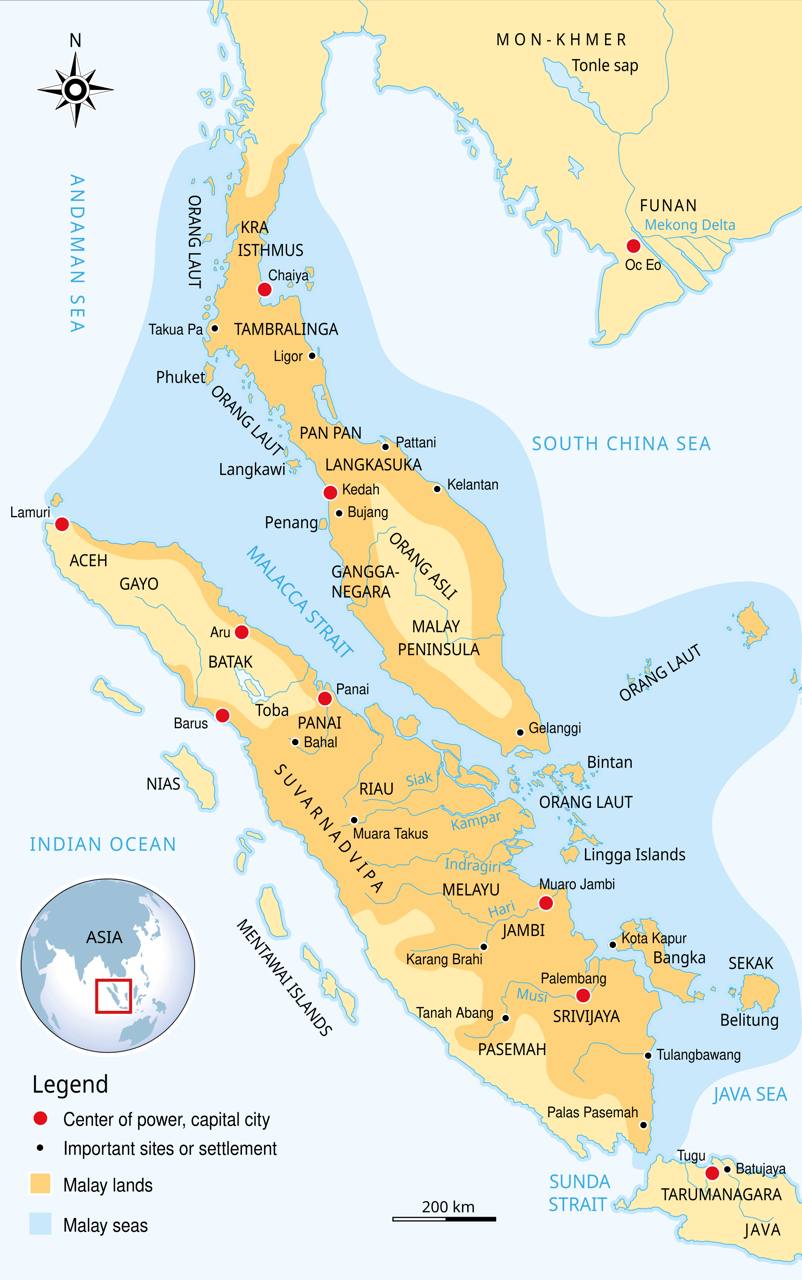
Chinese, Arabic, and Greco-Roman sources record camphor trade from regions associated with Barus. Chinese records refer to camphor from Po-lu, widely understood as Barus. Arabic geographical works also describe camphor-producing areas in Southeast Asia.34 This trade can be traced back to at least the early centuries of the Common Era.
This evidence supports Hamka's broader claim that camphor from the archipelago was known in the Middle East before Islam. It does not establish that the Arabic term Kafur came directly from Malay.
Discussion
Hamka's view is not explicitly supported in the tafsir tradition, which avoids identifying Kafur with a specific earthly substance or place. The dominant approach emphasises analogy rather than historical specificity.
Interdisciplinary evidence, however, gives partial support. Science confirms the properties and uses of camphor, historical records substantiate trade between Southeast Asia and the Middle East, and linguistic studies allow for Malay influence in the transmission of the term.35
His interpretation is therefore not definitive, but it is not without foundation. Its value lies in broadening the interpretive framework of Qur'anic studies.
Conclusion
Traditional tafsir does not support a direct identification of Kafur with camphor from Barus, yet evidence from other disciplines partially corroborates Hamka's broader thesis. His reading shows the value of interdisciplinary work in Qur'anic studies, and also the need for methodological rigour and honesty about the limits of the evidence.
The meaning of Kafur in the Qur'an remains open. Hamka's contribution reminds us that the study of revelation can benefit from engagement with a wide range of intellectual traditions.
This article is translated and condensed from the original Malay article in Muhammad Haniff Hassan (2023), Tafsir 'Ilmi Ayat-ayat Kauniyat MABIMS: Tumbuh-tumbuhan, Brunei: MABIMS, pp. 220-36.1
Notes
1.This article is translated and condensed from the original article in Malay in Muhammad Haniff Hassan (2023), Tafsir 'Ilmi Ayat-ayat Kauniyat MABIMS: Tumbuh-tumbuhan, Brunei: MABIMS, pp. 220-36, at https://haniff.sg/artikel-panjang/artikel-perkataan-melayu-dalam-al-quran-analisa-tentang-pandangan-unik-pak-hamka/ (accessed on 8 May 2026). ↩
2.Hamka (1988), Tafsir Al-Azhar, Singapore: Pustaka Nasional, vol. 10, pp. 7790-1. ↩
3.Ibid. ↩
4.See Naimul Qohar (2022), Teori masuknya Islam di Nusantara Dalam tafsir Al-Azhar, at https://tafsiralquran.id/teori-masuknya-islam-di-nusantara-dalam-tafsir-al-azhar/ (accessed on 8 May 2026). ↩
5.Hamka (1988), Tafsir Al-Azhar. ↩
6.Emily Cronkleton (2019), How to Use Camphor Safely: Benefits and Precautions, at https://www.healthline.com/health/what-is-camphor (accessed on 8 May 2026). ↩
7.National Parks Flora and Fauna Web (2022), Dryobalanops aromatica, 18 February, at https://www.nparks.gov.sg/florafaunaweb/flora/2/8/2862 (accessed on 8 May 2026); M. Grieve, Camphor, at https://www.botanical.com/botanical/mgmh/c/campho13.html (accessed on 8 May 2026). ↩
8.JSTOR Global Plants, Ocotea usambarensis, at https://plants.jstor.org/compilation/Ocotea.usambarensis (accessed on 8 May 2026). ↩
9."Rosemary" (2025), Drugs.com, 20 June, at https://www.drugs.com/npp/rosemary.html (accessed on 8 May 2026). ↩
10.D. E. Lincoln and B. M. Lawrence (1984), "The volatile constituents of camphorweed, Heterotheca subaxillaris", Phytochemistry, 23:4, pp. 933-4. ↩
11.Choi J.K. (1997), Longevity Way with Traditional Ethnopharmacology in Korea (Tojong Yakcho Jangsubeob), Seoul: Taeil Publication. ↩
12.Chinese Pharmacopoeia Commission (2010), Pharmacopoeia of the People's Republic of China, Beijing: People's Medical Publishing House, vol. I. ↩
13.Richa Singh and Talal Jawaid (2012), "Cinnamomum camphora (Kapur)", Pharmacognosy Journal, 4:28, March-April, pp. 1-5. ↩
14.Airina Zamri (2020), Kapur Barus: Kegunaan Dan Bahaya Yang Anda Perlu Tahu, at https://www.ceriasihat.com/kapus-barus-kegunaan-dan-bahaya-yang-anda-perlu-tahu/ (accessed on 8 May 2026). ↩
15.Nawal Nasrallah (2010), Annals of the Caliphs' Kitchens: Ibn Sayyar al-Warraq's Tenth-century Baghdadi Cookbook, Leiden: Brill, p. 70. ↩
16.Wilfred H. Scoff (1922), "Camphor", Journal of the American Oriental Society, vol. 42, pp. 355-70. ↩
17.Darbin Kumar Poudel et al. (2021), "The Chemical Profiling of Essential Oils from Different Tissues of Cinnamomum camphora L. and Their Antimicrobial Activities", Molecules, 26:17, p. 5132; Wang J. et al. (2017), "Comparative chemical composition and antifungal activity of the essential oils of Cinnamomum camphora L. Presl Leaves from three geographic origins", Food Science, 38:12, pp. 131-6; Zaizhi Liu et al. (2019), "Application of a combined homogenate and ultrasonic cavitation system for the efficient extraction of flavonoids from Cinnamomum camphora leaves", Analytical Methods in Chemistry, 7 February, pp. 1-12; Tite Xu et al. (2020), "Chemical composition and larvicidal activities of essential oil of Cinnamomum camphora (L.) leaf against Anopheles stephensi", Rev. Soc. Bras. Med. Trop., 27 January, pp. 1-5; How Jiang et al. (2016), "GC x GC-TOFMS analysis of essential oils composition from leaves, twigs and seeds of Cinnamomum camphora L. Presl and their insecticidal and repellent activities", Molecules, 21:4, pp. 1-12. ↩
18.MedlinePlus (n.d.), "Camphor overdose", National Library of Medicine, at https://medlineplus.gov/ency/article/002566.htm (accessed on 8 May 2026); Lee SH et al. (2022), "Phytochemistry and Applications of Cinnamomum camphora Essential Oils", Molecules, 27:9, 22 April, pp. 1-10. ↩
19.M. Grieve (n.d.), "Camphor", Botanical.com, at https://www.botanical.com/botanical/mgmh/c/campho13.html (accessed on 8 May 2026). ↩
20.See I. Gubelmann and H. W. Elley (1934), "American Production of Synthetic Camphor from Turpentine", Industrial & Engineering Chemistry, 26:6, pp. 589-594. ↩
21.See the interpretation of 76:5 in tafsir works by al-Tabari, al-Zamakhshari, al-Razi, al-Qurtubi, Ibn Kathir, al-Baidawi, al-Jalalain, al-Shawkani, al-Laith al-Samarqandi, al-Mawardi, al-Baghawi, al-Nasafi, al-Khazin, al-Tha'alabi, al-Suyuti, al-Jazairi, al-Sa'di, al-Alusi, Ibn 'Ashur, and Tantawi, at www.altafsir.com. See also Tantawi Jawhari (1417H), al-Jawahir fi tafsir al-Quran al-Karim, Egypt: Mustafa al-Babi al-Halabi wa Awladuh, vol. 21, p. 311; Wahbah al-Zuhaili (1991), al-Tafsir al-Munir, Beirut: Dar al-Fikr al-Mu'asir, vol. 29, p. 288; M. Quraish Shihab (2017), Tafsir al-Mishbah, Jakarta: Lentera Hati, vol. 14, pp. 657-8; Ahmad Sonhadji (1997), 'Ibr al-Athir: Tafsir al-Quran, Kuala Lumpur: Pustaka Salam, vol. 29, p. 5506; Muhammad Widus Sempo et al. (2019), "Kearifan tempatan Mengenai Kapur Barus (Cinnamomum Camphora) Menurut Perspektif Islam Dan Budaya Masyarakat Melayu Abad Ke 19M", Al-Abqari: Journal of Islamic Social Sciences and Humanities, 19:1, September, pp. 79-81. ↩
22.See another example in the Qur'an, 47:15. ↩
23.Narrated by al-Bukhari, at https://sunnah.com/bukhari:1258 (accessed on 8 May 2026). ↩
24.Narrated by Muslim, at https://sunnah.com/muslim:2254 (accessed on 8 May 2026). ↩
25.Narrated by al-Tabrani, at https://www.islamweb.net/ar/library/content/84/16414/ (accessed on 8 May 2026). ↩
26.See Muhammad Widus Sempo et al. (2019), "Kearifan tempatan Mengenai Kapur Barus". ↩
27.Saipolbahrin Ramli et al. (2018), "Analisis Leksikografi dan Semantik Perkataan al-Kafur dalam Al-Qur'an", GEMA Online Journal of Language Studies, 18:2, May, pp. 273-4 and 278-81. ↩
28.al-Ma'ani (n.d.), Kafur, at https://www.almaany.com/ar/name/كافور/ (accessed on 8 May 2026); Alankaa (n.d.), Al-Kafur, at https://alankaa.com/etymology/الكافور (accessed on 8 May 2026); Ma'ajim (n.d.), Kafur, at https://www.maajim.com/dictionary/كافور (accessed on 8 May 2026); Seslisozluk (n.d.), Camphor, at https://www.seslisozluk.net/en/what-is-the-meaning-of-camphor/ (accessed on 8 May 2026); Fine Dictionary (n.d.), Camphor, at https://www.finedictionary.com/camphor (accessed on 8 May 2026); Simon Online (2016), Kaffor, 5 May, at http://www.simonofgenoa.org/index.php?title=Kaffor (accessed on 8 May 2026); Alexander S. Eremin (2020), "Arabic Borrowings in the Lexical-Semantic System of the English Language: Etymological Analysis", Theoretical and Applied Linguistics, 6:2, pp. 14-25. ↩
29.Seslisozluk (n.d.), Camphor; Fine Dictionary (n.d.), Camphor; Simon Online (2016), Kaffor; Alexander S. Eremin (2020), "Arabic Borrowings in the Lexical-Semantic System of the English Language: Etymological Analysis", Theoretical and Applied Linguistics, 6:2, pp. 14-25, at http://rrlinguistics.ru/en/journal/article/2060/ (accessed on 8 May 2026). ↩
30.Online Etymology Dictionary (2017), Camphor, 22 September, at https://www.etymonline.com/word/camphor (accessed on 8 May 2026); Merriam-Webster Dictionary (2023), Camphor, 26 February, at https://www.merriam-webster.com/dictionary/camphor (accessed on 8 May 2026); Educalingo (2023), Camphor, March, at https://educalingo.com/en/dic-en/camphor (accessed on 8 May 2026); WordReference (n.d.), Camphor, at https://www.wordreference.com/definition/camphor (accessed on 8 May 2026). ↩
31.Alfred H. Schoff (1922), "Camphor", Journal of the American Oriental Society, vol. 42, pp. 359-66; Medieval Indonesia (2020), Camphor in the Qur'an, 11 May, at https://indomedieval.medium.com/camphor-in-the-qur%C4%81n-8201083b17f6 (accessed on 8 May 2026); Medieval Indonesia (2020), Two Early Descriptions of Camphor Production, 26 December, at https://indomedieval.medium.com/two-early-descriptions-of-camphor-production-ba3054e60375 (accessed on 8 May 2026). ↩
32.Nurfaisal (2013), Kesaksian barus dan kapur barus dalam sejarah awal Islam Nusantara, Pekanbaru: LP2M UIN Suska Riau, p. 22; Teuku Ibrahim Alfian (1999), Wajah Aceh Dalam Lintasan Sejarah, Banda Aceh: Pusat Dokumentasi dan Informasi Aceh, p. 1. ↩
33.Muhammad Widus Sempo et al., "Kearifan tempatan Mengenai Kapur Barus"; Esther Katz (2001), "Pengolahan Kemenyan di Dataran Tinggi Batak: Keadaan Sekarang", in Claude Guillot (ed.), Lobu Tua Sejarah Awal Barus, Jakarta: Pusat Penelitian Arkeologi Yayasan Obor Indonesia, p. 251; Paulo Zuccarini (2009), "Camphor: Risks and benefits of a widely used natural product", Journal of Applied Sciences and Environmental Management, 1:2, pp. 69-74; Irini Dewi Wanti (2006), Barus: Sejarah Maritim dan Peninggalannya di Sumatera Utara, Banda Aceh: Balai Kajian Sejarah dan Nilai Tradisional, p. 21; Misri A. Muchsin (2017), "Barus dalam sejarah: Kawasan percaturan Politik, Agama dan Ekonomi Dunia", ADABIYA, 19:1, February, p. 3. ↩
34.Misri A. Muchsin (2017), "Barus dalam sejarah", p. 4; R. A. Donkin (1999), Dragon's Brain Perfume: A Historical Geography of Camphor, Leiden: Brill, p. 105; Roderich Ptak (1998), "Possible Chinese references to the Barus area (Tang to Ming)", in C. Guillot (ed.), Histoire de Barus: Le Site de Lobu Tua, Paris: Cahiers d'Archipel 30, pp. 119-47; Irini Dewi Wanti (2006), Barus: Sejarah Maritim, p. 22; Dada Meraxa (1973), Sejarah Masuknya Islam ke Bandar Barus Sumatera Utara, Medan: Sasterawan, p. 16; Jane Drakard (1989), "An Indian Ocean Port: Sources of the Earlier History of Barus", Archipel, vol. 37, pp. 53-82. ↩
35.Alexander S. Eremin (2020), "Arabic Borrowings"; Waruno Mahdi and Russel Jones (2008), "Loan-words in Indonesian and Malay", Archipel, vol. 76, pp. 321-2; Waruno Mahdi (2005), "Linguistic and philological data towards a chronology of Austronesian activity in India and Sri Lanka", in Roger Blench and Matthew Spriggs (eds.), Archaeology and Language IV: Language Change and Cultural Transformation, London: Routledge, pp. 165, 212-7. ↩
Related Articles

Islam and Ageing: Foundational Reflections
Developing Excellent People, Building Excellent Institution: An Islamic Foundational Perspective on Mosque Leadership