

By
Ust Dr Muhammad Haniff Hassan
Fellow, S Rajaratnam School of International Studies, Nanyang Technological University Singapore
Website: https://haniff.sg/en/
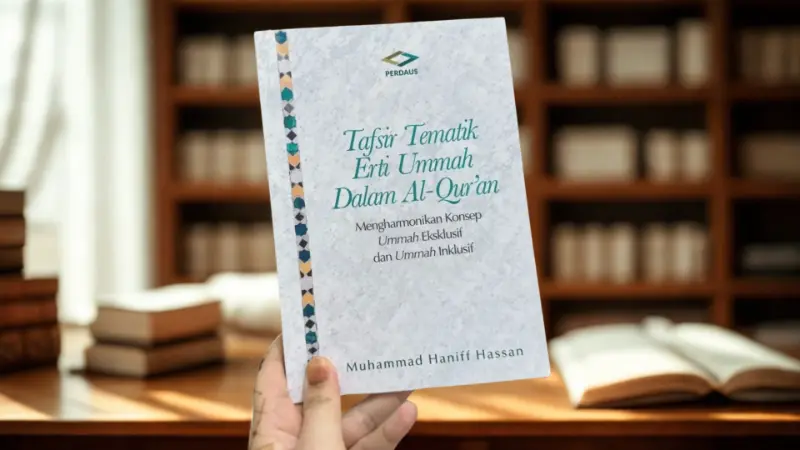
| Book Title | Tafsir Tematik Erti Ummah Dalam Al-Qur'an: Mengharmonikan |
|---|---|
| Publisher | Perdaus |
| Year | 2025 |
| ISBN | 978-9-819-42692-8 |
| Language | Malay |
| Pages | 104 |
An Overview
This book examines the longstanding tension between two visions of ummah – exclusive and inclusive - which have traditionally been viewed as opposing and contradictory. It revisits this traditionally binary vision of ummah and offers theological arguments to harmonise them. Such an endeavour is presently absent from the current literature. It is hoped that this book marks a humble contribution to the current corpus of contemporary Islamic knowledge.
The book typifies the genre of Islamic contemporary issues by studying the concept of a modern ummah, types of Muslim social identities, and relations between Muslims with non-Muslims.
By drawing on various ijtihad tools found in Islamic jurisprudence, this book offers a reconciliatory perspective. It suggests that the two visions can be understood as two distinct social identities that a Muslim can hold simultaneously: one connecting them with fellow Muslims globally (exclusive ummah), and the other linking them to a multi-religious society as citizens of a shared state (inclusive ummah). This perspective aligns with social identity theory, which recognises the natural coexistence of multiple identities within an individual person.
Targeted Audiences
The book hopes to reach these target audiences with a view of facilitating an internal reflection and opening further dialogue with others.
The first group are Muslims who are comfortable with a social identity that includes non-Muslims. They have internalised this societal norm as virtuous and rational. However, they do not have a grasp on the Islamic viewpoint of embracing an inclusive identity. It is hoped that book will be able to enlighten, enrich, and guide their existing knowledge about Islam – where their faith is not simply a ritualistic religion but also a reflection of their day-to-day interactions with others.
The second group are Muslims who embrace an inclusive social identity, but waiver when challenged by the opposing view that such an inclusive identity is frowned upon, or may lead to a dilution of their faith, piety and religiosity. Some hold the view that it may also tarnish the purity of being Muslims, because a person who associates with non-Muslims would risk eroding their own religious convictions. It is hoped that the book will give them a theological perspective that grounds their confidence alongside their intellectual and spiritual resilience.
The third group are those with an incorrect understanding of Islam. They may be exposed to the wrong ideas about Islam, be it from Muslims or non-Muslims, where such misinterpretations are prevalent in mainstream and online media platforms. They view Islam with various negative connotations - a religion that is exclusive, supremacist, hostile towards non-Muslims, etc. It is hoped that the book can offer some level of course correction to these misguided views.
The fourth group are those who mistakenly hold to the view that Muslims cannot subscribe to the norms of belonging to an inclusive ummah because Islam commands Muslim to disavow positive relations with all non-Muslims. The book seeks to correct this misconception.
The Need for Socialising Inclusive Ummah
This urgency to socialise the norms of an inclusive ummah arises from a belief that it has strong roots in our long Islamic traditions - such as the history of Muslims living in Habshah, Charter of Medina and the Qur'an. The book covers these traditions in greater depth.
In more recent times, the Southeast Asian region witnessed two waves of Islamic revivalism, which has significant impact on Singaporean Muslims as well. The first wave was in the early 20th century, and the second wave was in the late 1970s. The first wave had a fervent anti-colonial spirit which catalysed the struggle for independence. In this context, the idea of ummah became a rallying call to unite Muslims against the non-Muslim or kafir Western colonial power. The idea of exclusive ummah became an entrenched necessity, while inclusive ummah was frowned upon, as it was akin to fraternising with the enemy. The idea of exclusive ummah remained relevant in the post-independence period due to the concerns of neo-colonialism. The early period of this second wave was marred with anti-Western views which permutated into negative attitudes towards all non-Muslims. This partly explains why the idea of exclusive ummah was featured so prominently within contemporary Islamic discourse.
Although the idea of inclusive ummah has its roots in Islamic intellectual traditions, it remains a recent phenomenon among scholarly circles. This resurgence likely began in mid-1990s when contemporary Muslim scholars, especially those who lived in the West, began to discuss extensively about the need for a special fiqh intended for minority Muslims. At first, the discussion sought to guide Muslims on how they can practice Islam in the context of living in a non-Muslim country. This nuanced take was needed since fiqh was written for a different context in the classical books. Later, the discussion expanded to the idea of integrating minority Muslims with the larger non-Muslim societies. Henceforth, the idea of European Muslims, Western Muslims, British Muslims, American Muslims, began to take shape. There was great interest in the question of what it means to be Muslims as citizens in a non-Muslim country.
Unfortunately, the emergence of Al-Qaeda and ISIS exploited the gap within the discourse of exclusive and inclusive ummah. The concept of exclusive ummah was ingrained within certain parts of the Muslim world which strained and polarised Muslims and non-Muslim relations. It ultimately culminated in violent jihad such as the 9/11 attack. More can be done in the effort to fill this gap.
On balance, this book is not simply an exercise in religious pragmatism. It is an attempt to intellectually reclaim and re-introduce the lost tradition of championing an inclusive ummah. There are at least two contemporary Muslim scholars who are currently championing these ideas.
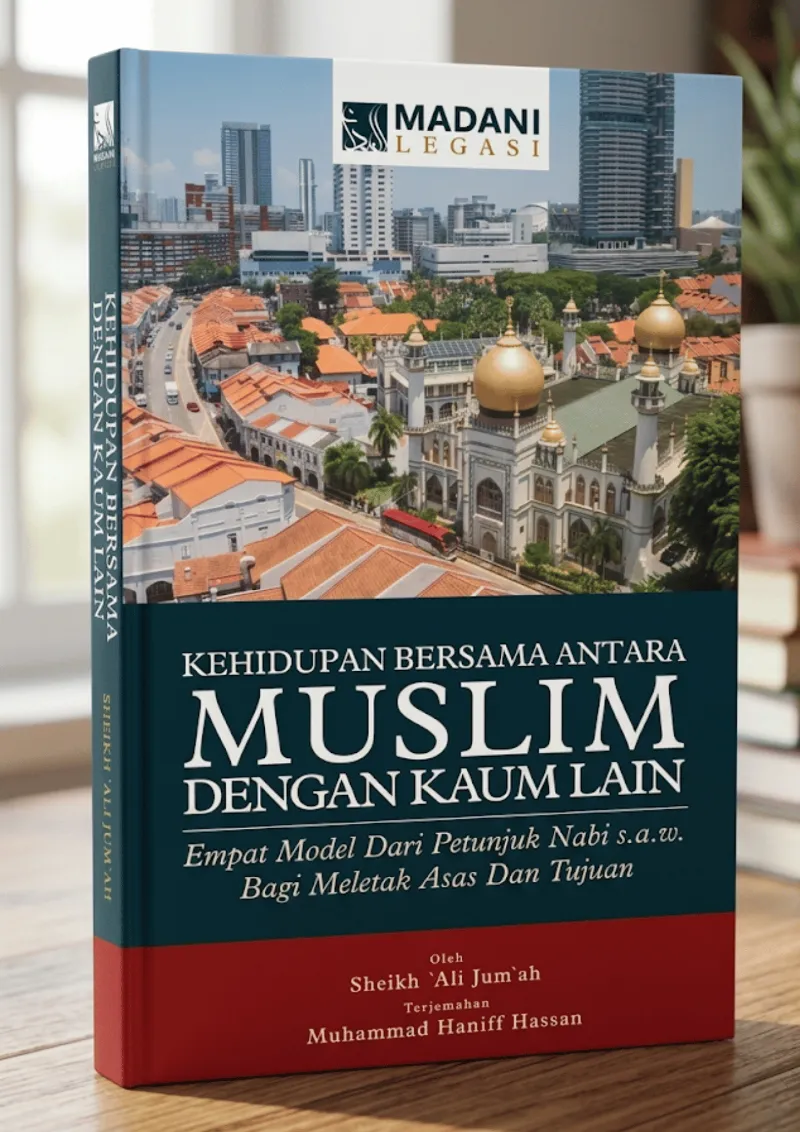
The first is Sheikh `Alī Jum`ah, the former Grand Mufti of Egypt, authored a book titled Al-Namazij Al-Arba`ah min Hady Al-Nabiy Fi Al-Ta`ayush Ma`a Al-Akhar (Four Models of Prophetic Guidance on Social Cohesion), published in 2013. The book has been translated into Malay and English.
Another scholar is Sheikh Abdullah bin Bayyah who initiated the 'Marrakesh Declaration on Rights of Religious Minorities in the Muslim World' in 2016. One of the points of the declaration states: "We call upon Muslim scholars and intellectuals around the world to develop a jurisprudence of the concept of 'citizenship' which is inclusive of diverse groups. Such jurisprudence shall be rooted in Islamic tradition and principles and mindful of global changes."
This book also has the added value of offering a Singaporean context which may provide instructive guidance for other multi-cultural societies. Singapore's Muslim community and its future generations may find this book useful in terms of theological guidance on living with the realities of a secular socio-political environment with a non-Muslim majority. The book offers a step forward in expanding shared spaces with confidence-building tools that preserves harmony and enhances social resilience.
Readers are invited to read the book which may provide them with the necessary theological foundations to build conviction in their faith and address theological challenges in these modern times. Given the nuanced complexities of our contemporary world, this book highlights the importance of our Islamic intellectual tradition – through the framework of ijtihad – which allows for interpretive flexibility and adaptability.
The book can be purchased from Perdaus via online order or at its Bedok centre at Blk 125 Bedok North Road #01-115 Singapore 460125. Contact Perdaus at welcome@perdaus.org.sg.
The introduction of the book is also available in video, in Malay and English. A full interview is available on Ust Dr Muhammad Haniff's website at https://haniff.sg/en/video-en/video-full-interview-on-my-book-on-reconciling-exclusive-and-inclusive-ummah/.